Showing posts with label Churchy stuff. Show all posts

Friday, December 09, 2016

HOLINESS AND MISSION


Twenty years ago, on December 9, 1996, I received the Sacrament of Holy Orders for the first time when I was ordained a transitional deacon by Bishop John R. McGann, the second Bishop of the Diocese of Rockville Centre.  On the day of my ordination I wrote the following, in a journal I was keeping:
Everything is new.  All of life is different now.  God let me enter into this awe and wonder more and more.  Let me let go and experience the mystery of your presence.Thank you. I love you and love what you have done for me.  Thank you for this sacrament, this grace, this love.  Keep me from being jaded, arrogant.  Let me always be the servant that I am called to today.
It was good to read these words again today as I reflected on these twenty years.  They renew me in the fervor that I had and remind me of the mission I understood myself being called to by God. The sixth months between that day and my ordination to priesthood were an opportunity for me to "fall in love," with my identity as clergy - one who is ordained to serve.

It was with particular joy that on this the 20th anniversary of my ordination to the Diaconate, Pope Francis announced his appointment of our new diocesan bishop, Bishop Joseph O. Barres. Bishop Barres episcopal motto is "Holiness and Mission," derived from a phrase from the final section of the encyclical Redemptoris Missio written by Pope Saint John Paul II.  In the document, His Holiness identified the Church’s missionary spirituality as "a journey towards holiness.”  In Bishop Barres appointment today I am reminded that my mission of service to the church is intimately tided to my own journey toward holiness.  

May I ask all who read this blog to pray that I may be faithful to his mission and that our new bishop will lead the church on Long Island to holiness through his own personal journey to holiness.

Thursday, November 24, 2016

Thanksgiving LAFTR

Thanksgiving Homily 2016

“Go home to your family and announce to them all that the Lord in his pity has done for you.”

The Gospel passage just proclaimed tells us that, having been set free from the demons that has possessed him, the man implores he may be allowed to get into the boat and depart with Jesus.  But the Lord tells him to “go home to his family.”  In my mind I imagine him pleading with Jesus again – “Go home to my family?  Where do you think my demons came from?”  I imagine that some gathered here this morning, at Thanksgiving mass may be thinking the same thing as you anticipate the day ahead.

In seriousness though, there are legitimate questions here.  Why was the man’s initial instinct to get in the boat and follow the Lord; rather then return to family and friends?  Earlier in this chapter, St. Mark describes the gravity of this man’s possession:

The man had been dwelling among the tombs, and no one could restrain him any longer, even with a chain. In fact, he had frequently been bound with shackles and chains, but the chains had been pulled apart by him and the shackles smashed, and no one was strong enough to subdue him. Night and day among the tombs and on the hillsides he was always crying out and bruising himself with stones.

Because of his possession, this man’s humanity was no longer recognizable. His shame at what he had become may very well have removed any desire he had to face the family he once knew. In addition, wouldn’t it be hard for his family and friends to accept such a change?  Would he still be seen as the possessed one?  Such is the case in our own family dynamics.  Over the course of our lives, we change, for better and for worse.  We might have shame for past indiscretions and old wounds.  Further, while we may recognize growth and conversion in our lives, others may refuse to do so or be unable to see those changes.  Like the formally possessed man, our anxiety over others disbelief or lack of mercy is real and can keep us from sharing who we have become.

So why then does the Lord not let the man remain with him?  Most assuredly Jesus would have been aware of such fears, but this moment of healing happens for this man “and for many.” Who better to be a witness to the good God has done then one with whom we are familiar?  This man’s family and friends knew the depth of his possession, only they could appreciate the magnitude of the healing.  Jesus heals and sends them man back to his family so that he may be an evangelist; a bearer of good news and a cultivator of faith.  The man does as Jesus tells him and – all were amazed.  Or more literally from the Greek translation - they all marveled and wondered.  In simply telling the story of what happened to him, the man provoked within others a desire to know the work of God.

We give thanks today because as St. Paul says, Jesus Christ strengthens and considers us worthy to be his ministers. [1Timothy 1:12] The word that we give to the blessed sacrament we receive today is “Eucharist;” a Greek word meaning, thanksgiving.  By this Holy Eucharist we are strengthened so we can be bearers of the good the Lord has done for us.  Regrettably our instinct is to keep this thanksgiving private.  We recoil from the notion of evangelization and are particularly averse to considering ourselves one to our friends and family.  But Jesus kicks us out of the comfort of this boat and commands us, if we are truly thankful for what we receive in this Eucharist, to go back to our families and tell them all that the Lord has done for us.

So what am I asking us to consider today?  Am I asking you to approach the Thanksgiving table with a bible in one hand and the catechism in the other?  Probably not a good idea.  Your family might think you are as possessed as the man in the Gospel.  Let me show you a subtler way.  The first pastor I served with as a priest, liked to offer acronyms as a way of remembering his homily.  So let me offer you one to guide you today.  Using the first letter of words taken from this morning’s scriptures I offer you the acronym LAFTR, L-A-F-T-R, LAFTR

Love – In first reading the prophet Isaiah tells us, because of love, the Lord redeems.  We are called to tell love stories.  Not just tales of romance, but the ways in which love, or our passion for someone, or something, brought about change in our life.

Amazed – The people were amazed at the man’s story in the Gospel and therefore pondered this divine intervention.  What ability, talent, skill or act of kindness have you observed in someone or even yourself?  Find an opportunity to share your wonder and awe, allowing another to be aware of mystery that comes from the divine presence.

Faithful – In the second reading St. Paul tells us that God is faithful to us.  So often we tell the tales of infidelity.  We repeat gossip or relate how we’ve been wronged. A story of another’s faithfulness can counter that negative inclination and restore hope in the fidelity of God and those he sends into our lives.

Thanks While this one might seem obvious, remember how St. Paul begins that second reading, “I give thanks to my God always on your account for the grace of God bestowed on you in Christ Jesus.”  We can so quickly point out flaws in the other.  St. Paul give thanks for the gifts of God that he observes in the people.  In so doing he shows us how necessary it is to acknowledge the good we see in the other.  This is particularly important to offer to those who lack esteem and self-worth.

Recall – The passage from Isaiah begins with his commitment to recall the loving deeds and acts of God.  How many of our gatherings of family and friends devolve into the rehashing of old arguments or past mistakes?  Instead recall a shared memory of the good of your lives, the blessings you have encountered and the joy you have shared. Positive recollection transforms that inclination to dwell on the negatives of the past and instead establishes hope in remembering the good the Lord has done for us.

As you go back to your families today, in a moment when the attention turns to you or better yet, if you have the courage to initiate a conversation, interject some LAFTR - love, amazement, faith, thanks, recall - and be the thankful evangelist the Lord has called you to be.

In his proclamation that created the national Thanksgiving holiday in 1863, amidst the Civil War, President Lincoln, asked the Almighty to heal the wounds of the nation & restore peace, harmony, tranquility & union.  It is with the very same desire that we go forth from the Lord’s Table today.  We need to be bearers of Good News at our Thanksgiving tables today.

A CNN poll has found that 53% of Americans dread the idea of talking about the Presidential election over dinner today.  There are also found numerous articles online suggesting topics other than the election to be discussed at family gatherings, so as to avoid strife.  There is a need for healing and not more animosity in our world.  So I pray that as a result of the strength we receive in this Holy Eucharist, this sacred thanksgiving; we may be grateful for the opportunity to go home to our families, enjoy the blessing of a meal shared and through LAFTR announce to all, the good the Lord has done in us.

Happy Thanksgiving.


Tuesday, December 08, 2015

WE DESIRE MERCY - NOT MONGERING


The Catholic Church has begun a universal celebration of an Extraordinary Jubilee Year of Mercy. This is more than an a marketing theme or a catchy slogan put forth by the church.  The Jubilee is a year which celebrates the remission of sins and the alleviation of suffering that comes from sin. It is a time of reconciliation and of conversion through sacramental penance. It is a year dedicated to solidarity, hope, justice and serving God in the spirit of joy and peace with everyone. Above all, the Jubilee Year is a year of Christ, the giver of life and of grace to humanity. It is called a “Holy Year” because it is celebrated with sacred rites and its mission is the holiness of human life.  A Jubilee year is referred to as "Ordinary," if it falls after a set period of years (generally 50 or 25 years); and extraordinary if it is declared as a celebration of an event of outstanding importance.  Pope Francis has declared an Extraordinary Jubilee Year dedicated to the theme of mercy, "as a special time for the Church, a time when the witness of believers might grow stronger and more effective." Misericordiae Vultus 3 I very much agree with the Holy Father, we are in a time when mercy is most needed.  The world needs Good News and the act of mercy is authentic preaching of that Good News.

I found it sadly ironic, however, that on the day Pope Francis marked the beginning of this jubilee year by the opening the Holy Doors of St. Peter's Basilica, the most merciless of statements was made by a front running candidate for the presidency of the United States, calling for the barring of all Muslims from entering the United States (immigrants and visitors alike.)  This declaration follows a more recent one, which sought a mandatory registry of all Muslims living in the United States. This candidate calls himself a Christian, but no man or woman of any faith can hold these positions.  

Long before Pope Francis, Pope Saint John Paul II wrote an encyclical on mercy.  One significant point he made was that the human thirst for dominance has left no room for mercy.
The present-day mentality...seems opposed to a God of mercy...The word and the concept of "mercy" seem to cause uneasiness in man, who, thanks to the enormous development of science and technology, never before known in history, has become the master of the earth and has subdued and dominated it. This dominion over the earth, sometimes understood in a one-sided and superficial way, seems to have no room for mercy. Dives in Misericordia 2:3

Saint John Paul goes on to say that this desire for domination, as opposed to mercy, leads to a false sense of justice.
Often programs which start from the idea of justice...in practice suffer from distortions. Although they continue to appeal to the idea of justice...other negative forces have gained the upper hand over justice, such as spite, hatred and even cruelty...The desire to annihilate the enemy, limit his freedom, or even force him into total dependence, becomes the fundamental motive for action; and this contrasts with the essence of justice, which by its nature tends to establish equality and harmony between the parties in conflict. Dives in Misericordia 12:3
Exclusion from society because of one's religious identification can not be accept as a just response to violence and terror.  Such a perspective is not only unjust to the persons to which this is applied, but it also accelerates intolerance, which will ultimately lead to the justification for persecution of any and all faiths.  One only needs to remember the famous poem First They Came by Rev. Martin Niemoller to be awakened to the dangers of a ideological bigotry.  If we can not show mercy, we can not expect that it will be shown to us.

Mercy is relational, not ideological. The deep wounds of our world are the result of merciless acts of those who do not know God.  May this year of mercy bear fruit for those who share our faith and our culture as well as in the lives of those we fear. 
    

Wednesday, September 30, 2015

ROMEWARD BOUND - A personal reflection on the visit of Pope Francis

Many have asked if I was able to see the Pope during his visit to New York.  I was fortunate to have attended vespers at St. Patrick's Cathedral and the Mass at Madison Square Garden.  The Mass at MSG was particularly special because it was the first time that I concelebrated mass with a Pope.  As a seminarian I attended 4 masses with Saint John Paul II, three of them in Rome and one here in the U.S.  One of the masses with him in Rome was in his private chapel with the opportunity for a personal audience after the mass.  I had the honor of distributing Holy Communion at Yankee Stadium during Pope Emeritus Benedict XVI's visit in 2006.  But the mass with Pope Francis was a unique gift, joining my brother priests in the section behind the altar and sharing in the offering of the sacrifice of Christ with the Vicar of Christ himself was truly one of the most sacred moments of my life as a priest. That being said the most personal moment of the Pope's visit was vespers at St. Patrick's on the evening before.


When I was a new college graduate, I worked for a time in New York City.  During those months, I would go to St. Patrick's Cathedral and pray in front of the Blessed Sacrament in the Lady Chapel.  As I was asking God to me help to understand what I was called to do, I was mindful of the din of the city noise outside.  In that chapel, I found comfort in the peaceful presence of our Lord and clarity in my discernment.

Almost one week ago,  I sat in that same cathedral awaiting the arrival of Pope Francis. With the assembly gathered, I prayed the rosary using beads given to me by Saint John Paul II. Unlike my visits long ago, there was no noise emanating from outside the cathedral. All I could hear was the peaceful prayer of God's people awaiting our Holy Father. When the Pope arrived, he processed through the cathedral and went directly to the Lady Chapel, and then he prayed before the very same altar, my altar, where I first prayed about my vocation.  How incredible this was.


The words Pope Francis spoke that night were powerful and encouraging to me.  The Holy Father took me back to where it began for me. Having now the perspective of 18 years of priesthood, it was an incredible reaffirmation of the discernment that began right there, 25 years ago.
During the homily, Pope Francis said
We can get caught up measuring the value of our apostolic works by the standards of efficiency, good management and outward success which govern the business world. Not that these things are unimportant! We have been entrusted with a great responsibility, and God’s people rightly expect accountability from us. But the true worth of our apostolate is measured by the value it has in God’s eyes. To see and evaluate things from God’s perspective calls for constant conversion.

Those words articulated the reasons I sought the sabbatical experience that begins for me this week.I depart this Sunday afternoon to participate in the Institute for Continuing Theological Education, at the North American College in Rome.  I will spend a little more than the next 7 weeks there.  I am grateful, humbled and a bit anxious about these weeks ahead.  At the institute, I will be engaged in coursework dedicated to preaching and evangelization in the modern era.  In addition, the city of Rome provides both a symbolic and tangible experience of returning to the roots of personal faith as well as the mission of the church. I look to this immersion as a means of strengthening my faith and deepening my encounter with Jesus Christ and His Church. 
I am a person who feels most comfortable at home.  I desire to be close to my family and my ministry.   It is with  some anxiety that I take this time. It is truly hard for me to let go.  But I am eager to follow Pope Francis, back to Rome and along the path of priestly ministry that he is leading us.
I anticipate that I will find opportunities  to share the experience via this blog in the weeks ahead. I ask you to pray for me. 


Friday, May 22, 2015

PENTECOST & MEMORIAL DAY - Renew the Face of the Earth

There is growing expectation for Pope Francis' soon to be released encyclical on the environment. Some may question why the Pope would devote a teaching letter to this issue.  Most certainly we know that we are called to be good stewards of the earth.  A pope writing on such an issue is not simply concerned with the physical preservation of the planet.  The state of the physical environment is also a symbolic expression of the state of the world and its people.

The world can be painful place but it was not created to be so.  The biblical image of the Garden of Eden is a metaphor of God's design.  Our broken humanity alone is responsible for the pain. A selfish disregard of the worlds physical resources is indicative of the selfish disregard for other lives. Unfortunately one of our reactions to the pains and sorrows of life is the perpetuation of that pain, through our selective outrage to injustice. Protests which bring injustice to light are important. Fighting within ourselves, however, or the demonizing of a class of people or law enforcement only increases the pain.  And media fueled outrage for a select agenda only enhances the divide.  


If our outrage was genuine would there not be riots over the shooting death of a 14 year old boy? 


If we truly cared about injustice would not the shooting death of a police officer and mother of a new born child cause an outburst of indignation.   

Or if all lives matter shouldn't we be outraged that nearly 1 in 3 minority children are aborted every year? http://www.washingtontimes.com/news/2015/jan/21/j-kenneth-blackwell-black-abortions-a-crisis-in-am/

As we celebrate Pentecost this weekend we also celebrate Memorial Day and remember those whose lives were lost in service to the protection of life.  We do not honor those who died for peace with the perpetuation of violence.  We do not respond to injustice with further violations of justice. And we do not reserve our outrage to those protests which are politically correct or elevated by the media. We can not seek the physical healing of the earth without understanding that the healing of humanity is constitutive to that effort.
May this classic prayer to the Holy Spirit be our guide for what we seek, renewal, a fire of love and wisdom

Come Holy Spirit, fill the hearts of your faithful and kindle in them the fire of your love.
Send forth your Spirit and they shall be created. 
And You shall renew the face of the earth. 
O, God, who by the light of the Holy Spirit, did instruct the hearts of the faithful, grant that by the same Holy Spirit we may be truly wise and ever enjoy His consolations, 
Through Christ Our Lord, Amen.

Saturday, May 09, 2015

A mother's love is of God...and we need more of it.

At mass this weekend, the scripture readings speak of God’s love and the unconditional nature of it.   They are fitting words as we celebrate our mothers and give thanks for the ministry of motherhood.  In many ways, a mother’s love is the best example of what God’s love “looks like.”  Its not always pretty and to the outside observer, it may not make sense.  This week I found a reflection that I found both unimaginatively compassionate and at the same time hard to accept.  I want to share it with you because it is a genuine example of the conflicted love we try to live.  They are the words of a teacher named Becki Norris, who testified during the penalty phase of the man convicted of the Boston Marathon bombings. In her explanation for testifying she said in part:
Over the past two years, I have had to accept that a kind and gentle temperament is not a lifetime guarantee, and a smart and caring child can go far, far down an evil path...I testified to help the jury see why he might be spared the death penalty. I also hoped to show him, in spite of what he has done, that someone cares about him as a person....
I urge you to read the whole reflection in its entirety, (Why I Testified On Behalf Of Dzhokhar Tsarnaev) because I know that in reading it I was challenged to ask, "Is this what Christians are supposed to do?  Is this what the mandate to love is all about?"  Personally I don’t know.  

I share her thoughts, not to validate them or to say that you too should feel this way.  Victims of violence, especially the victims of this act, can not and are not called to feel this way - but is not someone?  I was particularly struck by the line, “I hoped to show him, despite what he has done, that someone cares about him, as a person.”  Love sees beyond the act and recognizes the person.

We have all heard the phrase which labels someone as one whom, “only a mother can love,” and we all have encountered people in life, that only God can love.  As disciples we have to challenge ourselves, once in a while, to be the person through which God loves the “unlovable.”  It is most certainly not easy to love.  Mrs. Norris' life would be less challenging if she never loved this young man, if she was ignorant of his unique humanity that engaged her.  But she dared to love this student, and now she bears the pain of that love. Would she have preferred not to have ever known and loved him?  Would a mother prefer to have never loved her child?  Would God?

Love is of God, it is not an act of human manifestation.  In a world that continues to be torn apart by violence - we seek a divine intervention.  We seek love and God seeks to love -- through us.  The world can not heal without love.  We desperately pray for peace, for freedom from terror and terrorist.  We pray that there be less people in the world like this man.  But we also must pray for more people like this teacher and mother.  On this Mother’s day, may the divine ministry of motherhood provide us an example and a challenge to love one another as we have been loved.


Thursday, March 13, 2014

Do You Accept? One year later.

As we approached the first anniversary of the election of Pope Francis, I knew that I wanted to offer some kind of reflection on him and the phenomena that the first year of his pontificate has been.  I was not interested in offering some kind of analysis of his impact or a presenting a survey of the various ways in which his words or actions have been received.  In my wonderment of what was intriguing me to say anything, I found myself focusing my thoughts on the man himself and what this year has been for him personally. 

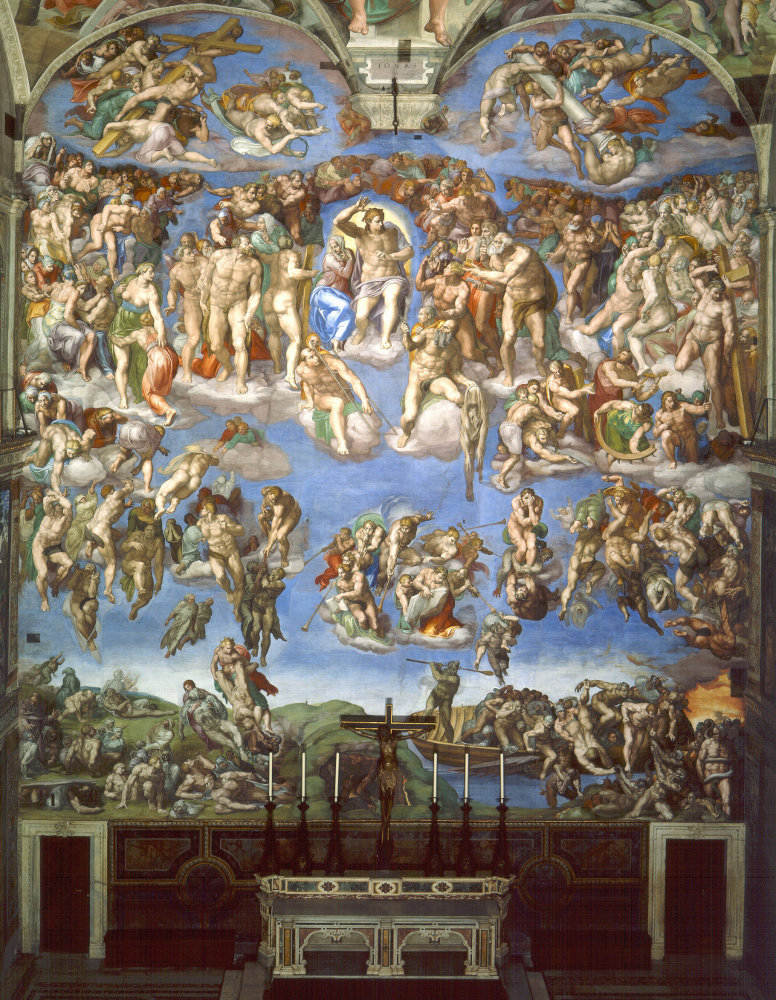
When I was growing up I liked games shows with celebrity contestants as well as talk shows because I was intrigued by the fact that these stars were real people and I wanted to know what they were really like.  In Pope Francis, I think we have had the opportunity to know "the real man."  In both his prepared remarks and his unscripted comments, the Holy Father has shown an appreciation for the every challenges of discipleship.  He balances his public appearance with a public glimpse of normal routine life.  And because of all that, I found myself thinking back to a year ago and wondering, what was he thinking as it was clear his life was about to change. What was he thinking as the Dean of the College of Cardinals asked him, "Do you accept?"  I can't know what he was thinking but I do know what he saw during those moments, Michelangelo's great fresco, "The Last Judgement."

I have been blessed to visit the Sistine Chapel twice in my life.  My first experience was like many tourists, not knowing where to look while you are quickly ushered through.  The second time I went, I made a choice that I would spend my brief time focused on the this scene of The Last Judgement. I could not help but be overwhelmed by it.  It was not a static two dimensional painting that I saw, but an image of great movement; people being swept up to heaven with the Lord's right hand and others sliding into the netherworld after confronting the forearm of his left.  "Which direction am I headed?"  I asked myself.  In one united gesture, the resurrected and glorified body of Christ says, "Come inherit the Kingdom, to you did it for me." and "Depart to you who did not do it for me."  With this image before him, Cardinal Jorge Mario Bergoglio said, "Accepto" in acceptance of his election as Supreme Pontiff of the Roman Catholic Church. I believe it is with this image in mind, that Pope Francis has lived this first year of his pontificate.  He has asked us in his preaching, teaching and action if we are willing to accept the standards of this Last Judgement.

"Who am I to judge?" is possibly the most quoted statement of the Holy Father thus far. Many have used it to say that the Holy Father felt that he, and therefore no one else, had the right to make a definitive statement about sin. His answer was not, that there is no judgement, but that he is not the judge.  It is the Son of Man, Matthew's gospel says, that will come in glory and judge on the standard of what we have done for Him.  I don't know what he was thinking when he accepted the call to serve as Pope but I do know that in his year as our Holy Father, Pope Francis has sought to bring us to a favorable final judgement by directing us to the least among us.

"Do you accept?" is the question of discipleship.  Do you accept the mandate to do for me, who did it for you?  Do you accept the challenge to die to self service and selfishness.  Do you accept the admonition to do for the least not because you recognize Christ in them but more importantly when you can't see the good in them?  Do you accept the cross of laying down your life for the will of the Father and the care of His people?

I can only wonder how hard it was for Pope Francis to say "Yes," but I know for certain how hard it is for me to say, "Yes," to this standard of judgement.  I truly believe that our world today has made it harder and harder to say, "Yes," to this standard of judgement.  The threat of terror and a failing economy force us to worry more about ourselves. A plague of objectification afflicts us due to the proliferation of pornography.  Even our technology has developed cameras for our phones that make it easier to take pictures of ourselves and therefore be less focused on remembering our moments with others.  

I think Pope Francis understands how hard it is for us to accept the standard of the Last Judgement.  A year ago I prayed that the new Pope would make me a better person and a priest.  In coming to "know" him, I know that he has accepted the mission to help me understand the measure by which I will be judged and has challenged me to say, "I accept." 

Thursday, March 06, 2014

A Spark Amidst the Ashes


Some time ago, during a at home Holy Communion call, I struck up a conversation with the elderly woman I was visiting.  I asked her about her children, her late husband's job and the place where she raised her family.  Sadly, she could not remember much about these things.  She could not remember all the names of her children and grandchildren, the name of the town where she raised them or what her husband did to support them.  And she knew it.  She told me how sad she was that she could not remember.  I then asked her if she could remember the street she grew up on.  Her eyes lit up and she told me the name of the street in Brooklyn.  I asked her if she could remember the name of her parish and the light in her eyes was there again as she said the name.  Not only could she remember who she was, her sadness turned to joy as she told me about that place that was not so far away, but very present in her mind.  The spark of her true self still burned.


I thought of this visit as we marked the beginning of the season of Lent, with Ash Wednesday.  I was almost surprised to see our church so full at 7:30 last night, because after the crowds we experienced throughout the day, it was hard to believe that there was anyone left in our town who had not come to receive ashes, but fill the church once more they did.  The response to this day is hard to figure out, the phone calls inquiring about the times for distribution started a week earlier.  What is it that makes them come? Perhaps it is similar to the spark of recognition that I saw in the woman I visited.  For the Ash Wednesday crowds, the spark of faith and true identity is still burning.

Traditionally the ashes used on this day come from the palm branches used at the beginning of Holy Week, a year ago.  A year ago, Holy Week concluded and Easter began with the new fire.  That new fire was used to light the candles held by the congregation at the Easter Vigil. On that night the church was aglow with all of these individual flames of faith.  Throughout the year we all did our best to keep the flame of faith burning.  The passion of our faith carried us through the joys and sorrows of the year, but despite our best efforts it began to dim and the ash began to build.  The spark however is still there.

The Gospel we use on Ash Wednesday seems a bit incongruent for the occasion. Here we are publicly signing ourselves with an outward symbol as we listen to a gospel passage that tells us to keep our penitential acts secret.  Our public act of being signed with ashes is simply a communal recognition of the private work that now begins.  The ashes remind us of our mortality and that despite our attempts to live good lives, we are not yet good enough.  We have work to do.  The spark of faith will becoming a growing flame if we do the private work of prayer, fasting and almsgiving throughout these next 40 days.  The public act of Ash Wednesday reveals to us that the ember of faith is still there.  We do not simply remember what we once were, but we are recommitted to being our true selves made in the image and likeness of God.  Ash Wednesday calls us to fan the ember of faith through acts of penance and spiritual renewal. 

The phone calls and the crowds of Ash Wednesday always bring me hope, because I believe that the experience is a revelation of the spark of faith that still burns among the ashes of our lives.  I know that among the crowds there were many who had not been to church for a very long time. They were there with those who are in church every day and every week -- and each one of us has become ashen over time.  We forget who we are and the light of faith has dimmed - but through this simple sign, we remember who we are and we inspired not to travel back in time, but live today, alive in faith.  


When I was a Boy Scout, I learned to never assume that a campfire was completely out, there could always be an ember still burning that could light a new fire.  As a priest and more importantly as a disciple, I have learned to never assume that the light of faith is completely burned out, there could still be an ember amidst the ashes of ones life.  Somehow the tradition of Ash Wednesday makes that spark come alive so that the soul who desires it may be renewed in the weeks ahead.

Wednesday, February 05, 2014

Social Media Famous or Letting Your Light Shine?

You are the light of the world...your light must shine before others, that they may see your good deeds and glorify your heavenly Father.

This passage from Sunday’s Gospel is part of Jesus’ well known “Sermon on the Mount.” Jesus is  calling his disciples to stand up and be counted, to put themselves out there and be known. It may sound like he is calling them to be attention seekers and to strive for fame. The problem is that being known as a follower of Jesus during his life time and in the first 300 years of the church meant martyrdom. Who wants that kind of fame? He was truly asking them to risk their own  lives so that the truth of the Gospel and the  promise of eternal life might be known, especially to those whose lives were without hope. Let your  light shine, not for your own glory but for the glory of God and the salvation of others.

Isn't that call to “fame” so different from the drive for fame that exists in our time? For the last two  decades “reality television” created a new breed of celebrity, people who became famous not for any  talent or achievement, but rather because of  media and self-promotion. The fame gained  through reality television has been enhanced and even surpassed by the technology of social  media. Facebook, YouTube, Instagram, Vine and other similar venues have enabled the average  person to have millions of “followers.” I recently read an article which reported on conventions which bring online celebrities to local venues  where they can meet and greet the thousands of fans that show up. 

While this modern day pursuit of celebrity may be perceived as innocent fun, it is also quite dangerous. Most of the most famous online celebrities are young people in their teens. We know that teenage life straddles the line of wanting attention and desiring privacy. We know the painful history of childhood celebrities, creating more young celebrities only creates unhealthy scrutiny of these young lives. It also makes them vulnerable to predatory behavior. Surely, not all of the millions of followers, that online celebrities enjoy, are simply adoring teenage crushes. 

While not everyone becomes famous online, similar dangers exist for all who expose their lives  to social media. Children are using this technology more and more and they access it not through the  easily monitored home computer, but through the electronic devices they carry about with them. With this kind of access to the world, they are vulnerable to online bullying. In the past, a young person may have had to deal with a playground antagonist now there is no escaping that adversary. In the past, mean notes were slipped into a locker or backpack, now those hurtful attacks are public for the viewing of all. Rumors which were once dependent on the passing of whispers are now easily forwarded to hundreds and thousands of others. Curious adolescent chatter has moved beyond the sanctity of the locker room and now exists permanently in cyberspace. 

Social media has its benefits but without the intense supervision of caring adults, this new era of fame is dangerous and destructive for our children. Jesus calls us to let our light shine, to not be afraid to be public witnesses of the Gospel. We are called to be such witness even in social media. We all share in the responsibility of keeping our children safe; helping them to avoid unhealthy self-promotion and teaching them that even they have the ability and responsibility to let the light of their faith shine.

Saturday, November 02, 2013

Saints, Souls and Psychic Mediums


Since we are surrounded by so great a cloud of witnesses, let us rid ourselves of every burden and sin that clings to us and persevere in running the race that lies before us while keeping our eyes fixed on Jesus, the leader and perfecter of faith.
Hebrews 12:1-2a
November is a liturgical month of remembrance, beginning with the Solemnity of All Saints and the Commemoration of All Souls.  The month of remembrance concludes with the end of the church year, the Solemnity of Christ the King.  Our personal remembrances throughout this month, are seen through the lens of our celebration of the gift of eternal life lived by the saints and the proclamation of Christ’s victory over sin and death as priest, prophet and king.  As the quote from the Letter to the Hebrews teaches, we live our lives knowing that we are surrounded by the witness of those who have gone before us and we commit ourselves to living with our eyes fixed on Jesus and the victory he has won for us. 
But what is our relationship with those who have gone before us who are not canonized saints?  First and foremost we live in hope that they are amongst those having received the gift of eternal life.  Our prayerful hope is that our loved ones are indeed among the saints.   The Catechism of the Catholic Church teaches:
Those who die in God's grace and friendship and are perfectly purified, live forever with Christ. They are like God for ever, for they "see him as he is," face to face. (1023)
We also know that anyone of us may die not in a state of grace but still bearing the stain of sin.  Therefore, the Catechism also teaches:
All who die in God's grace and friendship, but still imperfectly purified, are indeed assured of their eternal salvation; but after death they undergo purification, so as to achieve the holiness necessary to enter the joy of heaven. The Church gives the name Purgatory to this final purification of the elect, which is entirely different from the punishment of the damned. (1030-31)
Our relationship with those who have died is either one that asks for their intercession or prays for their ultimate joy of eternal life with God in heaven.  Our remembrance of the departed during this month and throughout our earthly pilgrimage is one that acknowledges the unbreakable bond of love and expresses our faith in the hope of the resurrection.
As we begin this month of remembrance I want to share with you some other thoughts regarding our relationship with our departed brothers and sisters, specifically as it relates to the cultural popularity of psychics and mediums.  The attention given to a celebrity medium in our community is what prompted me to address this issue, but these words are not intentionally directed at anyone in particular.  They are meant to share with you what the church teaches in this regard and to do so with charity.  Let me begin by once again quoting the Catechism of the Catholic Church
God can reveal the future to his prophets or to other saints. Still, a sound Christian attitude consists in putting oneself confidently into the hands of Providence for whatever concerns the future, and giving up all unhealthy curiosity about it.  (2115)
All forms of divination are to be rejected: recourse to Satan or demons, conjuring up the dead or other practices falsely supposed to "unveil" the future. Consulting horoscopes, astrology, palm reading, interpretation of omens and lots, the phenomena of clairvoyance, and recourse to mediums all conceal a desire for power over time, history, and, in the last analysis, other human beings, as well as a wish to conciliate hidden powers. They contradict the honor, respect, and loving fear that we owe to God alone. (2116)
What is the church trying to teach in these words?  First that such a reliance on “psychic” abilities is a rejection of God’s providence.  One seeks the wisdom of a medium because one is unwilling or unable to entrust their loved one to God, but must instead have a “confirmation” of what one would otherwise trust in faith.  Second, this teaching speaks to the danger of accepting a particular “power” that a person has over another person.  In this relationship a person who seeks the guidance of a medium is granting that person power over them.  That is to say, that unless one hears of their loved one through the medium, he or she cannot have peace.  The concern is also one that speaks to the perceived power the medium has over God.  If the medium speaks with surety, what need is there for faith in the eternal love of God?
A further reflection on this matter could also point to the fact that some who have purported to have psychic abilities are fraudulent.  Like any illusionist, they have developed their skills of deception and do so only for profit and entertainment.  Accepting that as fact, I would also propose that some may genuinely believe that they have a particular ability that allows him or her to be aware of this “great cloud of witnesses,” and desire to only help people with their “gift.”  Such people may not see themselves as attempting to have power over another or God.  What harm or objection is there to this attempt to “do good?”
In a very limited way, I would like to share with you three examples, in which the experience of psychic mediums is in conflict with the Christian life.  The first example is an absence of our fundamental belief in salvation through Jesus Christ.  The typical content of a psychic reading is earthly; whereas it focuses on personal history, the events surrounding death or a desire for the well-being of those who are left behind.  The message of the departed does not typically express thanksgiving for their salvation, nor do they ask for prayers longing for salvation.  Is this not problematic for us who profess a belief and hope in eternal salvation?  What is more hopeful, hearing that a passed loved one knows that we loved and cared for them, or a profession of faith expressing trust that the loved one is seeing God face to face?  As Catholic Christians we profess a belief that we are pilgrims on an earthly journey that leads us to heaven.  We cannot hold fast to any message that does not acknowledge either God’s kingdom or a longing for it.  A failure to acknowledge the role of Jesus Christ in one’s salvation is devoid of truth.
A second conflict for Catholics is that any attempt to “conjure spirit” is an act of opening ourselves to conjuring the Spirit of Evil and the Prince of Darkness himself.  Throughout salvation history, it is God who calls and bestows gifts of wisdom and insight.  The church does in fact recognize the gift bestowed upon mystics who have experienced wisdom from those who have gone before us, a recent example would be Saint Padre Pio who had a vision of the souls in Purgatory.  He received this vision so that prayers and sacrifices might be offered for those souls who longed for purification and eternal life. A vision that longs for the salvation of others is authentically Christian.  God calls but we do not conjure, for to conjure is an attempt to control or to seize divine power on our own.  Such attempts are what Satan himself is known for.  Moreover, spiritual gifts given by God are freely shared not used for profit.
Finally, the psychic medium phenomenon often presents a false teaching with regard to the soul.  Sometimes there will be a professed revelation of “past lives” or a medium will declare that the soul of a loved one lives on now in someone else.  Neither of these statements is consistent with our professed Catholic faith.  The soul is created by God and becomes a living human body as a unity of spirit and matter in one nature. (CCC 365) The soul is immortal; it does not perish at death but separates from the body to be reunited with that body at the final Resurrection.  In addition to being in direct conflict with our faith, a profession of reincarnation lacks any consolation or hope.  The last thing I would want to hear about a departed loved one is that they are still living here in this imperfect world, only to die again.  My hope and prayer is that they are with God, not dwelling in someone else.  Such a notion also lacks a respect for the individual that the soul is now purported to live in.  Imagine being told, you are not really you, but a deceased relative.  As Catholics we cannot accept any message that denies the unique nature of the soul and the explicit purpose of that soul to live in eternal union with God.
I hope that these words of reflection help each of us to understand how we relate to those who have gone before us.  We trust in God’s love and mercy for them.  We wait in hopeful expectation for our reunion with them.  We believe it is God alone who calls us and gifts us with a surety that allows us to profess that, “the souls of the just are in the hands of God.”