Sunday, September 11, 2016

After 15 years...a time to be found


These acts of mass murder were intended to frighten our nation into chaos and retreat. But they have failed. Our country is strong...

President George W. Bush, September 11, 2001


The memories of we have of lost loved ones are truly a blessing for us, however, they are never enough. As much as we come to value the blessing of memories, the pride we feel for the heroes of that day and the consolation that has assisted us these fifteen years -- we still long for what we lost. We know that we will never regain what we have lost. The lives as well as physical and mental health remain a loss for us; but what about the many other losses? In these 15 years we have lost security, trust, unity, civility and hope. Fifteen years later, the words of President Bush no longer seem to be true; our nation has been frightened into chaos and retreat. In the days, weeks and months following the terrorist attacks, despite its horrific impact.  I felt a unity like I had never known before. Now, fifteen years later, I feel a division and hostility that I never experienced before. As disturbing as it is to watch television footage of those days and the aftermath, I strangely find a sense of tranquility in the resilience, fortitude and unity they depict.
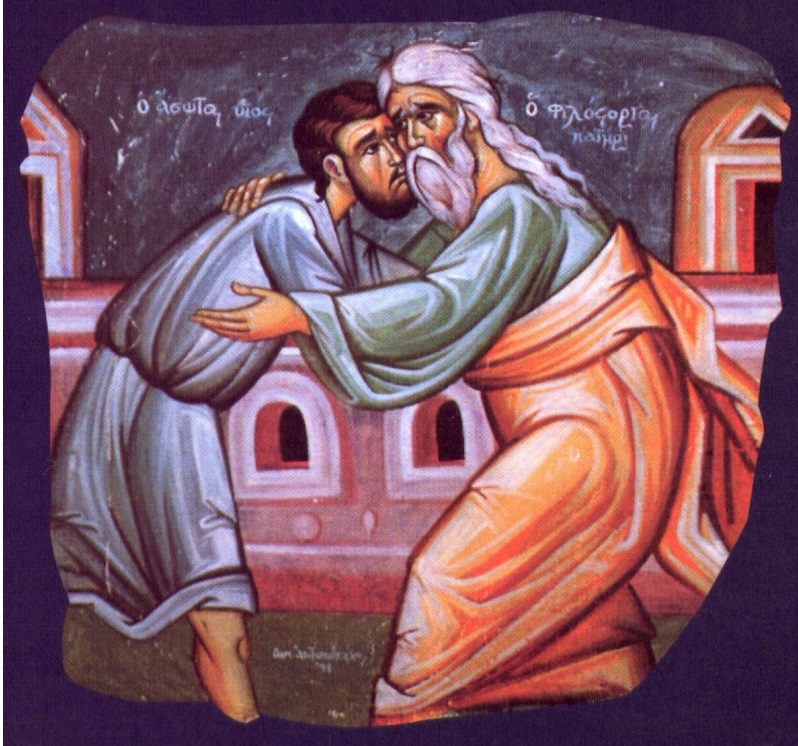

At Sunday Mass today, the Gospel reading included the parable known as the Prodigal Son.  Jesus offers the parable as means of understanding God the Father's insatiable quest for the lost.  The father of the parable rejoices that his scandalous son has returned as he joyfully proclaims that his son who was "lost" has been "found." The Greek work (in the original text) for the word "lost," apolōlōs, means to utterly destroy. And the Greek word translated as "found," heurethē, is also used to announce the pregnancy of the Blessed Mother; "Mary was found to be with child."  We might say then, that which is utterly destroyed is found alive only through God.

Memories are a blessing not simply because they help us to remember what we had, their blessedness is greatest when we realize what still remains. The resilience, fortitude and unity that I remember has not been lost, because they were signs of the Lord's presence. We remain in the abiding and loving presence of God but we feel lost.  We are like the lost sheep who knows it is lost but does not know how to be found.


On this 15th anniversary I pray for our nation that we may be found and that we may by the grace of God recover the security, trust, unity, civility and hope.  Many of those who have lead our country have caused chaos and a retreat from the communion we once knew.  And unfortunately there are those on the leadership horizon who seem to be setting a course deeper into the darkness.  It is therefore up to people of faith, to let God be God.  We seek to be found so that we can share in the recovery of what was lost. 

Saturday, August 20, 2016

College and the Big Kids

This week, like many others her age, my niece and only godchild heads off to college.  It is hard to believe this time has come.  As the saying goes, “they grow up too fast.”  I remember her informing me on her first day of kindergarten that the “big” kids on the bus said “bad words.”  Needless to say I was disturbed by this contamination of her five year-old innocence.  As she begins her college career I have some of the same feelings, although now it seems more appropriate to be concerned with the new outside influences she faces.  Her parents, like most, have raised an exceptional young woman in whom I have a great deal of confidence.  Yet as a protective godfather and a priest, I worry about the  encounter with new “big kids,” in her life.
As a spiritual father to many others who are at this same new beginning in their lives, I thought I would offer an open letter to my niece and all her fellow college students.
Dear College Student:
Congratulations!  With mixed feelings of excitement and anxiety you are about to begin the most important years of your life thus far.  You are in my prayers and I wish that you may be blessed with wisdom, fortitude and happiness.
Like all adults in your life, I have concerns about the  road ahead.  The world you will now encounter may not always support and validate what you have been taught  by your parents, role models and your faith. While it is important for us to be challenged on the path to greater wisdom - it is also important to recognize and respect the wisdom we have already been given.  So I offer you the following counsel .
Respect your freedom - You will now have a new found independence and with it comes responsibility.  You have the freedom to be faithful to your studies or to ignore them in the name of fun.  You have the freedom to experience new things as well as the freedom to make destructive decisions in the process.  You have the freedom to grow and evolve into an adult, but you also have the freedom to remain childish and irresponsible
Respect your body - You have heard that you have been created in the image and likeness of God and that your body is the temple of the Spirit.  These teachings are the truth and not just pithy sayings.  Respecting the body that God has blessed you with is a means of recognizing your own human dignity and a way to show others how you expect to be treated.  Respecting your body means being mindful of what you eat, getting the sleep you need, and being physically fit.  It also means that you must make good decisions with your use of alcohol and drugs (including those prescribed by a doctor.)  Respect for your body includes attentiveness to your sexuality.  Taking advantage of the body of another or allowing another to take advantage of yours for the sake of personal fulfillment is a disrespect of your body and what it is made for.
Respect your faith -  Practicing your faith and growing in it is an important part of your college years.  Now facing the challenges of an adult life you ought not to abandon the practice of faith but perhaps even increase it.  Be faithful to Sunday mass.  Many college campuses meet the needs of a college student by offering mass on Sunday evening.  Spend time with others who not only share your faith tradition but are also facing the same challenges and struggles which you are.  Cultivate a habit of prayer: pray the rosary, read the scriptures and talk to God daily.
Beloved college student, your families, your communities and your church wish you well and will keep you in our prayers.  In the words of Jesus, we hope that you will always strive  to “enter through the narrow gate,” [Lk13:24] and not take the easy way out.  Respect the person God has made you and your parents formed you to be.  GOD BLESS YOU!

Friday, December 25, 2015

The journey -- HOW DID YOU GET HERE?

For whatever reason, as a child, I remember adults often asking each other at social gatherings a question that I thought was strange.  Shortly after arrival, coats now off and initial greetings expressed someone could be heard asking, “How did you get here?

Tuesday, December 08, 2015

WE DESIRE MERCY - NOT MONGERING


The Catholic Church has begun a universal celebration of an Extraordinary Jubilee Year of Mercy. This is more than an a marketing theme or a catchy slogan put forth by the church.  The Jubilee is a year which celebrates the remission of sins and the alleviation of suffering that comes from sin. It is a time of reconciliation and of conversion through sacramental penance. It is a year dedicated to solidarity, hope, justice and serving God in the spirit of joy and peace with everyone. Above all, the Jubilee Year is a year of Christ, the giver of life and of grace to humanity. It is called a “Holy Year” because it is celebrated with sacred rites and its mission is the holiness of human life.  A Jubilee year is referred to as "Ordinary," if it falls after a set period of years (generally 50 or 25 years); and extraordinary if it is declared as a celebration of an event of outstanding importance.  Pope Francis has declared an Extraordinary Jubilee Year dedicated to the theme of mercy, "as a special time for the Church, a time when the witness of believers might grow stronger and more effective." Misericordiae Vultus 3 I very much agree with the Holy Father, we are in a time when mercy is most needed.  The world needs Good News and the act of mercy is authentic preaching of that Good News.

I found it sadly ironic, however, that on the day Pope Francis marked the beginning of this jubilee year by the opening the Holy Doors of St. Peter's Basilica, the most merciless of statements was made by a front running candidate for the presidency of the United States, calling for the barring of all Muslims from entering the United States (immigrants and visitors alike.)  This declaration follows a more recent one, which sought a mandatory registry of all Muslims living in the United States. This candidate calls himself a Christian, but no man or woman of any faith can hold these positions.  

Long before Pope Francis, Pope Saint John Paul II wrote an encyclical on mercy.  One significant point he made was that the human thirst for dominance has left no room for mercy.
The present-day mentality...seems opposed to a God of mercy...The word and the concept of "mercy" seem to cause uneasiness in man, who, thanks to the enormous development of science and technology, never before known in history, has become the master of the earth and has subdued and dominated it. This dominion over the earth, sometimes understood in a one-sided and superficial way, seems to have no room for mercy. Dives in Misericordia 2:3

Saint John Paul goes on to say that this desire for domination, as opposed to mercy, leads to a false sense of justice.
Often programs which start from the idea of justice...in practice suffer from distortions. Although they continue to appeal to the idea of justice...other negative forces have gained the upper hand over justice, such as spite, hatred and even cruelty...The desire to annihilate the enemy, limit his freedom, or even force him into total dependence, becomes the fundamental motive for action; and this contrasts with the essence of justice, which by its nature tends to establish equality and harmony between the parties in conflict. Dives in Misericordia 12:3
Exclusion from society because of one's religious identification can not be accept as a just response to violence and terror.  Such a perspective is not only unjust to the persons to which this is applied, but it also accelerates intolerance, which will ultimately lead to the justification for persecution of any and all faiths.  One only needs to remember the famous poem First They Came by Rev. Martin Niemoller to be awakened to the dangers of a ideological bigotry.  If we can not show mercy, we can not expect that it will be shown to us.

Mercy is relational, not ideological. The deep wounds of our world are the result of merciless acts of those who do not know God.  May this year of mercy bear fruit for those who share our faith and our culture as well as in the lives of those we fear. 
    

Sunday, November 29, 2015

WHAT IS YOUR PRAYER THIS ADVENT?

Saint Paul prays for the Christian congregation in the city of Thessalonica with these words. 


"Brothers and sisters: May the Lord make you increase and abound in love for one another and for all, just as we have for you." [1 Thes 3:1]


As we hear him pray for an abundance of love among fellow believers it is important for us to understand the context in which his prayer is offered is one of "Advent" spirit. St. Paul prays that there might be an abundant love among them, as an expression of faith in the anticipation of the return of Christ. May you love one another, not simply because it is a nice thing to do, but love because of your faith that Christ has come and will come again because of his love for us. 


The sense of “advent” was very real to even the earliest of the Christian communities. They lived their lives not assuming that the reunion with Christ was far off, but imminent. They also did not anticipate that coming in fear, but with a joyful expectation. For them and for us, that coming of Christ is something we long for; in history and in our own passing from this life. 


How do we prepare for that reunion? Do we anticipate meeting the Lord and offering him all the times we fought against something or will we be able to show him all the times our actions show what we were for? Will we present to him the times and places in which we acted with love, or we only be able to offer him the occasions of our righteous anger?  We he only see our lamentations of suffering or our works of mercy? 


Advent is a season of anticipation which leads us to celebrating the Christ in Jesus of Nazareth. It begins, however, as a time to anticipate the ultimate and final coming of Christ. We are called therefore to spend time, during this season, reflecting on the implications of that reality. The birth of Jesus is the Father’s response to humanity and so we prepare by reflecting on the forgiveness of God, God’s compassion, and God’s love. We look forward by looking back at where we have seen God in our lives and where we long for him in our future. 


I pray that as we begin this advent season that we actively anticipate the birth of Christ by reflecting, praying and loving. What is your prayer this Advent?


Friday, November 20, 2015

GRAZIE e ARRIVEDERCI

I thank all who have been a prayerful support and have shared my sabbatical with me.  Enjoy this farewell video.


PETER REMEMBERS

Relic of the chains which bound St. Peter during his captivity in Rome
The final week of my sabbatical program here in Rome was a retreat given to us by the theologian of the Papal Household, Fr. Wojciech Giertych, O.P.  Fr. Giertych's led us in examining the discipleship of Peter, as seen from the perspective of Mark's gospel. It has long been a tradition in scripture scholarship that the author of Mark's gospel is a companion of Peter, who writes for the Christian community in 1st century Rome.  For the purpose of the retreat, Father asked us to read this gospel as Peter remembering his time with Jesus.  From this lens, we were seeing the gospel's perspective not as one of triumph but also a reflection of Peter's regrets and failure's along the way. Peter is harsh on himself and the other disciples and therefore tells the story of the Good News, from one who was weak, sometimes failed and maybe perhaps wished he could go back and re-do what he had missed.  As Peter approaches death, he remembers what he has done and what he has failed to do.
Fr. Wojciech Giertych, O.P.

We were blessed with many insights during the talks, but the overall theme stuck with me.  As I leave Rome, part of my sadness is that I look back on the 7 weeks and reevaluate what I could have taken better advantage of.  I know that in my life too, I can get stuck on past failures and missed opportunities. Our meditation on Mark's Gospel, as Peter's reflection on his past, brought us to a closer realization and acceptance of the fact that it is not about our accomplishments and satisfaction.  "Thy will be done," we pray.  The Father's will is done, not through me but through Christ who chooses me as he chose Peter, with human weakness clearly evident. I may never feel completely accomplished, but the real measure is what has God accomplished through me. 

I don't think in offering us these insights we were being encouraged to not worry about our shortcomings, but rather to recognize the love of Christ for me, who fails, and because he loves me, he asks me as he asked Peter, "Do you love me?....Feed my sheep."

Celebrating Mass at the nearby church dedicated to St. Onafrio.
The rector of the church is the brother of a Holy Family parishioner

Sunday, November 15, 2015

SHEPHERDS WITH THE HEART OF CHRIST


Fr. Gerard Gentleman with Diocese of Rockville Centre Seminarians
Alexander Turpin, Michael Bissex and Leo Song
after celebrating Mass together at St. Peter's Basilica
"I will give you shepherds after my own heart" (Jer. 3:15).
In these words from the prophet Jeremiah, God promises his people that he will never leave them without shepherds to gather them together and guide them:

Saturday, November 07, 2015

MALTA - A Pilgrimage Experience

St. Paul's Island, Malta - The sight of the shipwreck of the vessel carrying the imprisoned St. Paul to Rome
In reviewing the outline of my Roman sabbatical program, the pilgrimage to Malta intrigued me on two levels.  First, I questioned how this fit the theme of the sabbatical module on evangelization and second, I wondered, what there really was to do in Malta. My questions were more then answered in these five days. 

Friday, October 30, 2015

A VIDEO UPDATE

We head for Malta tomorrow and won't be able to update the blog until I return next weekend.  So enjoy the update video

Sunday, October 25, 2015

IMAGINATION, The Art of Faith Proclaimed

The Chapel at Casa O'Toole - the site of the Institute of Continuing Education for Priests
at the Pontifical North American College
These days of sabbatical, which have been devoted to preaching, have often evoked a discussion on imagination.  Through these discussions I have come to a renewed understanding of the importance of creativity in preaching.

Monday, October 19, 2015

ASSISI - Discerning God's Holy Will

The Church of San Damiano outside of Assisi
The original cross was moved by the Poor Clares
to the basilica in Assisi dedicated to St. Clare
St. Francis of Assisi's Prayer before the Cross

Most high, glorious God, 
illuminate the darkness of my heart. 
Give me right faith,
certaihope,
perfect charity,
profound humility.

Give me Lord,
judgement and discernment
to fulfill your true and holy will.


The first time I can recall the word, "discernment," it

Sunday, October 11, 2015

FAMILY - Our deepest experience

 © Mazur/catholicnews.org.uk
Pope Francis prays before an icon of the Holy Family at the prayer vigil ahead of the opening of the Synod on Families
As the first week of my sabbatical nears its conclusion, I am very much mindful of my parish family back home.

Tuesday, October 06, 2015

OPEN THE WINDOW


When I arrived here at the Casa O'Toole on the grounds of the Pontifical North American College for the beginning of my sabbatical program, I was welcomed and taken to my room on the 3rd floor.  "Go over to the desk and open the window," the director of the program said to me.  When I did so, the view above is what I saw.  Today I moved some of the furniture around so I did not have to reach over the desk each day to open the window to let the awesome view of St. Peter's Basilica into my room.

In looking out onto this historic symbol of the Church and the incarnation of Christ from my room, I recalled words from Saint Ambrose that I read on the flight over.  In speaking of the admonition of Jesus to "go into your room (to pray,)" St. Ambrose comments...
But by “room” you must understand, not a room enclosed by walls that imprison your body, but the room that is within you, the room where you hide your thoughts, where you keep your affections. This room of prayer is always with you, wherever you are, and it is always a secret room, where only God can see you.
A hope for me during this blessed time is that I am opened in a new way to the voice of God.  I pray that I may open the window of my soul a bit more, so as to let the grandeur God enlighten my innermost being.  This too is the goal of preaching, the subject matter of my first 3 weeks here.  As a preacher, the words preached are most effective when they touch the inner soul of the hearer.  As a preacher, one must first be able to encourage the hearer to open the window of the soul, to let that word in.  
  
Before obeying the direction to "open the window," I asked, "why?"  "Just do it," my host said.  How often we are reluctant to be open, without knowing the outcome before hand.  As I begin my weeks here, I ask you to pray that I may be open to the Holy Spirit and the Word of God. Through this openness, may I grow in my own faith and therefore be able to offer to you God's word in a more effective way.  

Know that I pray for you, that you too might, "just do it," and open the window of your soul to the greatness of God.

Wednesday, September 30, 2015

ROMEWARD BOUND - A personal reflection on the visit of Pope Francis

Many have asked if I was able to see the Pope during his visit to New York.  I was fortunate to have attended vespers at St. Patrick's Cathedral and the Mass at Madison Square Garden.  The Mass at MSG was particularly special because it was the first time that I concelebrated mass with a Pope.  As a seminarian I attended 4 masses with Saint John Paul II, three of them in Rome and one here in the U.S.  One of the masses with him in Rome was in his private chapel with the opportunity for a personal audience after the mass.  I had the honor of distributing Holy Communion at Yankee Stadium during Pope Emeritus Benedict XVI's visit in 2006.  But the mass with Pope Francis was a unique gift, joining my brother priests in the section behind the altar and sharing in the offering of the sacrifice of Christ with the Vicar of Christ himself was truly one of the most sacred moments of my life as a priest. That being said the most personal moment of the Pope's visit was vespers at St. Patrick's on the evening before.


When I was a new college graduate, I worked for a time in New York City.  During those months, I would go to St. Patrick's Cathedral and pray in front of the Blessed Sacrament in the Lady Chapel.  As I was asking God to me help to understand what I was called to do, I was mindful of the din of the city noise outside.  In that chapel, I found comfort in the peaceful presence of our Lord and clarity in my discernment.

Almost one week ago,  I sat in that same cathedral awaiting the arrival of Pope Francis. With the assembly gathered, I prayed the rosary using beads given to me by Saint John Paul II. Unlike my visits long ago, there was no noise emanating from outside the cathedral. All I could hear was the peaceful prayer of God's people awaiting our Holy Father. When the Pope arrived, he processed through the cathedral and went directly to the Lady Chapel, and then he prayed before the very same altar, my altar, where I first prayed about my vocation.  How incredible this was.


The words Pope Francis spoke that night were powerful and encouraging to me.  The Holy Father took me back to where it began for me. Having now the perspective of 18 years of priesthood, it was an incredible reaffirmation of the discernment that began right there, 25 years ago.
During the homily, Pope Francis said
We can get caught up measuring the value of our apostolic works by the standards of efficiency, good management and outward success which govern the business world. Not that these things are unimportant! We have been entrusted with a great responsibility, and God’s people rightly expect accountability from us. But the true worth of our apostolate is measured by the value it has in God’s eyes. To see and evaluate things from God’s perspective calls for constant conversion.

Those words articulated the reasons I sought the sabbatical experience that begins for me this week.I depart this Sunday afternoon to participate in the Institute for Continuing Theological Education, at the North American College in Rome.  I will spend a little more than the next 7 weeks there.  I am grateful, humbled and a bit anxious about these weeks ahead.  At the institute, I will be engaged in coursework dedicated to preaching and evangelization in the modern era.  In addition, the city of Rome provides both a symbolic and tangible experience of returning to the roots of personal faith as well as the mission of the church. I look to this immersion as a means of strengthening my faith and deepening my encounter with Jesus Christ and His Church. 
I am a person who feels most comfortable at home.  I desire to be close to my family and my ministry.   It is with  some anxiety that I take this time. It is truly hard for me to let go.  But I am eager to follow Pope Francis, back to Rome and along the path of priestly ministry that he is leading us.
I anticipate that I will find opportunities  to share the experience via this blog in the weeks ahead. I ask you to pray for me. 


Friday, May 22, 2015

PENTECOST & MEMORIAL DAY - Renew the Face of the Earth

There is growing expectation for Pope Francis' soon to be released encyclical on the environment. Some may question why the Pope would devote a teaching letter to this issue.  Most certainly we know that we are called to be good stewards of the earth.  A pope writing on such an issue is not simply concerned with the physical preservation of the planet.  The state of the physical environment is also a symbolic expression of the state of the world and its people.

The world can be painful place but it was not created to be so.  The biblical image of the Garden of Eden is a metaphor of God's design.  Our broken humanity alone is responsible for the pain. A selfish disregard of the worlds physical resources is indicative of the selfish disregard for other lives. Unfortunately one of our reactions to the pains and sorrows of life is the perpetuation of that pain, through our selective outrage to injustice. Protests which bring injustice to light are important. Fighting within ourselves, however, or the demonizing of a class of people or law enforcement only increases the pain.  And media fueled outrage for a select agenda only enhances the divide.  


If our outrage was genuine would there not be riots over the shooting death of a 14 year old boy? 


If we truly cared about injustice would not the shooting death of a police officer and mother of a new born child cause an outburst of indignation.   

Or if all lives matter shouldn't we be outraged that nearly 1 in 3 minority children are aborted every year? http://www.washingtontimes.com/news/2015/jan/21/j-kenneth-blackwell-black-abortions-a-crisis-in-am/

As we celebrate Pentecost this weekend we also celebrate Memorial Day and remember those whose lives were lost in service to the protection of life.  We do not honor those who died for peace with the perpetuation of violence.  We do not respond to injustice with further violations of justice. And we do not reserve our outrage to those protests which are politically correct or elevated by the media. We can not seek the physical healing of the earth without understanding that the healing of humanity is constitutive to that effort.
May this classic prayer to the Holy Spirit be our guide for what we seek, renewal, a fire of love and wisdom

Come Holy Spirit, fill the hearts of your faithful and kindle in them the fire of your love.
Send forth your Spirit and they shall be created. 
And You shall renew the face of the earth. 
O, God, who by the light of the Holy Spirit, did instruct the hearts of the faithful, grant that by the same Holy Spirit we may be truly wise and ever enjoy His consolations, 
Through Christ Our Lord, Amen.

Saturday, May 09, 2015

A mother's love is of God...and we need more of it.

At mass this weekend, the scripture readings speak of God’s love and the unconditional nature of it.   They are fitting words as we celebrate our mothers and give thanks for the ministry of motherhood.  In many ways, a mother’s love is the best example of what God’s love “looks like.”  Its not always pretty and to the outside observer, it may not make sense.  This week I found a reflection that I found both unimaginatively compassionate and at the same time hard to accept.  I want to share it with you because it is a genuine example of the conflicted love we try to live.  They are the words of a teacher named Becki Norris, who testified during the penalty phase of the man convicted of the Boston Marathon bombings. In her explanation for testifying she said in part:
Over the past two years, I have had to accept that a kind and gentle temperament is not a lifetime guarantee, and a smart and caring child can go far, far down an evil path...I testified to help the jury see why he might be spared the death penalty. I also hoped to show him, in spite of what he has done, that someone cares about him as a person....
I urge you to read the whole reflection in its entirety, (Why I Testified On Behalf Of Dzhokhar Tsarnaev) because I know that in reading it I was challenged to ask, "Is this what Christians are supposed to do?  Is this what the mandate to love is all about?"  Personally I don’t know.  

I share her thoughts, not to validate them or to say that you too should feel this way.  Victims of violence, especially the victims of this act, can not and are not called to feel this way - but is not someone?  I was particularly struck by the line, “I hoped to show him, despite what he has done, that someone cares about him, as a person.”  Love sees beyond the act and recognizes the person.

We have all heard the phrase which labels someone as one whom, “only a mother can love,” and we all have encountered people in life, that only God can love.  As disciples we have to challenge ourselves, once in a while, to be the person through which God loves the “unlovable.”  It is most certainly not easy to love.  Mrs. Norris' life would be less challenging if she never loved this young man, if she was ignorant of his unique humanity that engaged her.  But she dared to love this student, and now she bears the pain of that love. Would she have preferred not to have ever known and loved him?  Would a mother prefer to have never loved her child?  Would God?

Love is of God, it is not an act of human manifestation.  In a world that continues to be torn apart by violence - we seek a divine intervention.  We seek love and God seeks to love -- through us.  The world can not heal without love.  We desperately pray for peace, for freedom from terror and terrorist.  We pray that there be less people in the world like this man.  But we also must pray for more people like this teacher and mother.  On this Mother’s day, may the divine ministry of motherhood provide us an example and a challenge to love one another as we have been loved.


Friday, February 27, 2015

Why Lent? Its a crazy thought.


If you follow my Twitter or Instagram accounts, you know I have spent the last few days in the frozen tundra of Sag Harbor on retreat.  I posted the pictures as a way of sharing the solitude of the experience, knowing that not many get the gifted opportunity of going on retreat.  I also wanted to make sure people knew I wasn't on a beach somewhere.  Actually, it was a beach, but you get the point, I hope.

Even though I am not a fan of winter, I find it is the best time for me to go on retreat. There is something about winter that encourages the necessary environment of solitude.  The season of Lent is also an opportune time for me - in that my spiritual psyche is directed toward renewal at this time of year.  I feel supported by the recollective spirit of the liturgical season.  A retreat is a restorative time that I think gives us the opportunity to believe in the possible, for me therefore, looking at frozen bays, several feet of snow and dead branches on trees helps me to have hope for new life.

Lent is therefore a time of retreat for all of us.  A time to believe in the hope that new life is possible.  We anticipate the celebration of the resurrection of the Lord and the renewed life of faith that is possible for each of us.  Our own renewal is important not just on a personal level but when we are renewed we see the world differently and we have an increased desire to bring about the change that we seek, as well as what the Lord wishes for us.

I want to share a brief insight, therefore, that was a part of my retreat reflection. As I began the retreat I was using the 15th Chapter of John's Gospel as a source for contemplation.  It is Jesus' discourse on the vine and the branches. The passage actually continues a bit into the 16th chapter.  It was there that I found these words.
 In fact the hour is coming when everyone who kills you, will think he is offering worship to God.         -John 16:2
Mindful of the martyrdom of the Coptic Christians in Egypt last week and the hundreds of Christians taken hostage in Syria this week, I thought to myself, surely this time has come.  I could not help myself be distracted in anger at those who do such things and the lack of leadership from our nation and the nations of the middle east.  This evil must be squashed. Good is much more powerful then this evil is it not? What a disturbing and disconsolate thought for a retreat.  I set the anger aside, however, and focused on myself throughout the next days.  But strange things happen on retreat, or more appropriately you think strange things.

I've been saying mass each day for me and the sisters who live here, as I prepared the readings today I had a strange thought when I read this passage from the first reading.
Do I indeed derive any pleasure from the death of the wicked? says the Lord GOD. Do I not rather rejoice when he turns from his evil way that he may live?     -Ez 18:23
Here comes the strange thought.  What if the Saddam Hussein's, Bin Laden's and the Hitler's of the world had had saw the error of their ways, under went a conversion, admitted they were wrong and asked forgiveness?  Wouldn't that have been more powerful then ending their evil with their deaths? Crazy right? Impossible even.  I told you, crazy thoughts come from retreats.  Surely it is hard for us to see this as possible, but can you understand why the Lord says the rejoicing comes not from the death of the wicked but in their conversion? God cares about souls first and foremost so there is no joy for God in lost souls. But think too of the power that conversion would have had in these examples. These men had power to do great evil, think of the power their conversion would have been.  Through evil, they had great influence, would their power be as great if they were to as they were as passionate in their conversion?  I know -- crazy thoughts.

But here is where I found myself going with this. At the beginning of the retreat I desired the destruction of evil but at the end I was musing on the greater power of conversion.  In our own lives we seek to destroy evil within ourselves. We try to root it out of our relationships and all that we encounter.  Isn't that why we discipline ourselves during Lent?  Actually its not.  We discipline ourselves so that we might be changed, that we might turn away from what is sinful not because we drive it out, but because through our Lenten journey we encounter the merciful love of God who gave his only Son. Christ comes not to destroy us or the evil with in, but to change us through mercy.  Could my greater sense of God's mercy for me influenced these crazy thoughts? I think so.

We all struggle with forgiveness.  How can I forgive the one who hurt me so much? Firstly, we forgive so that the evil which has been done to me no longer dominates me.  More importantly, we forgive so that mercy may prompt conversion.  We go through the retreat of Lent so that we might know mercy and be transformed by that mercy.  Transformed we understand the power of mercy, the power to save a soul rather than loose it. The power to not perpetuate death but dissolve its power.
I hope you can find some solitude during these weeks of Lent, so that you might have a greater awareness of what is possible in you and through you because of the mercy of the Father and the Son.
Why Lent?  Because only in the barren solitude would we have such crazy thoughts.